

Universal Guidelines for AI
Let's review a landmark document by the Center for AI and Digital Policy that can protect us from the harmful use of AI


That's where we are at this moment—opaque systems that the experts don't understand, increasingly being deployed by organizations that also don't understand these systems and an industry that says, “don't regulate us.” This is not going to end well.
Marc Rotenberg made this statement about the use of Artificial Intelligence in his discussion with Ralph Nader on the Ralph Nader Radio Hour on Nov. 20, 2024. Marc is the Executive Director and Founder of the Center for AI and Digital Policy (CAIDP) which is a global organization of leading AI experts and policy leaders from both governmental and NGO groups that promote and develop policies for a better, fairer society in the use of AI that respects fundamental human rights, democratic institutions and the rule of law. He is a leading expert in AI policy. He has served as an AI expert to the US Congress, the European Parliament, the OECD, UNESCO, judicial conferences, and other international organizations.
Mr. Rotenberg understands AI better than most human beings on this planet. So when he says that our current trajectory in using AI “is not going to end well,” we should heed his warning.
Artificial Intelligence has great transformative potential, both beneficial and detrimental to society and the environment. We will focus on the governance part of this evolving technology by taking a close look at the Universal Guidelines on Artificial Intelligence, which was the first comprehensive guideline on AI.
The 40th edition of the International Conference of Data Protection and Privacy Commissioners (ICDPPC) was held in Brussels in October 2018. This annual conference brings together the top technology leaders and data protection experts worldwide. The main mission of the ICDPPC, now called the Global Privacy Assembly (GPA), is to provide international leadership on data protection and privacy. Although the use of AI is not their primary focus, AI certainly has far-reaching implications for data protection and privacy. Under the leadership of the CAIDP, the Universal Guidelines on Artificial Intelligence (UGAI) was presented at this conference in the European Parliament and endorsed by a long list of organizations and leaders in technology (listed at the end of this article).
The UGAI is not the only guideline on AI, but it was the most comprehensive at the time. Since then, the United Nations and many countries have developed their own guidelines on the use of AI. UNESCO has a white paper called Recommendation on the Ethics of Artificial Intelligence. The OECD has a set of AI Principles. In both of these cases as with the UGAI, even though there are many signatory countries including the U.S., none of the guidelines are legally binding. Nevertheless, they are important documents because they influence the development of actual legislation and regulations in countries where they can hold companies and individuals accountable.
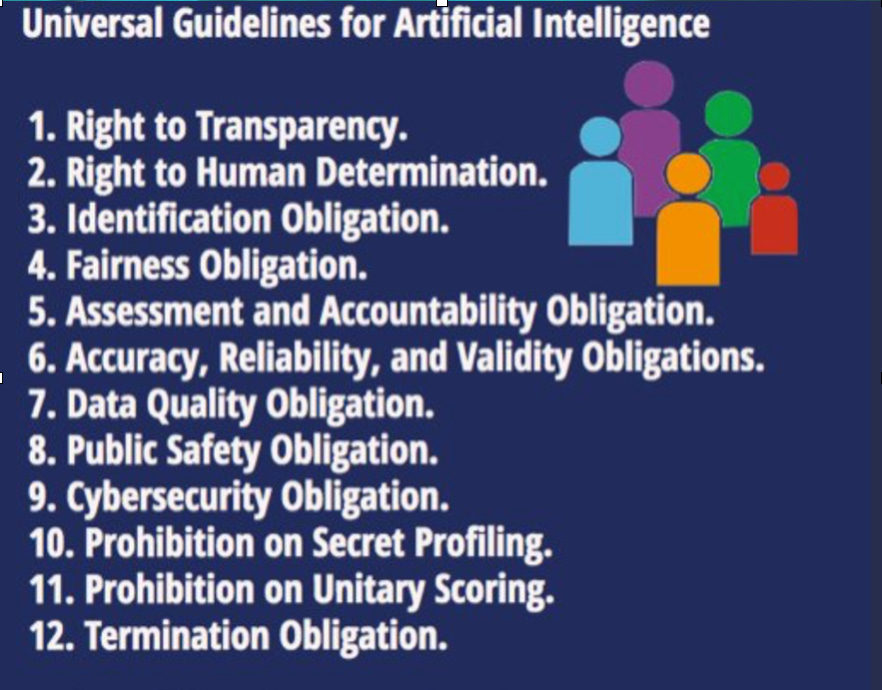
1. Right to Transparency
The key purpose of the Transparency Principle is to give the right to individuals to know the basis for adverse determinations as a result of an automated decision by an AI system. This calls for independent accountability for these decisions and puts the onus on the AI developers to explain the decision-making process. For example, if someone applied for health insurance through an AI automated form and was denied coverage, that person has a right to know why and how that decision was made.
2. Right to Human Determination
This principle puts the responsibility of automated decision-making back to the humans who created the AI system. In other words, the human creator is ultimately responsible even if a machine has made the decision independent of human interference. In a practical example, if an autonomous vehicle struck and killed a pedestrian dressed as a fire hydrant, it is not the vehicle’s fault but the developers who created the sensing identification systems that made a fatal error.
3. Identification Obligation
When you call a medical helpline, instead of getting a nurse on the line you get a chatbot, you must be notified that you are speaking with a chatbot and name the company or organization it represents. The purpose of this is accountability and transparency so the user knows what they are dealing with and who they need to contact if there are any issues.
4. Fairness Obligation
Datasets used in training AI systems may have an inherent bias towards certain races, genders or other physical attributes which may result in discrimination and unfair outcomes. For example, a study by MIT and Stanford University found that commercial facial recognition systems used in gender identification had error rates of 0.8% for lighter-skinned men but up to 34.7% for darker-skinned women. This misidentification could lead to false arrests, privacy violations and exclusion from opportunities. Language models may perpetuate stereotypes that exist in the dataset; for example, doctors would be male and nurses would be female.
This principle asserts that all datasets need to be evaluated to ensure that bias does not exist to produce objective and fair outcomes.
5. Assessment and Accountability Obligation
This principle asks a simple question, “Is your AI system ready to ship?” Before an AI system is deployed or released, it must be assessed on the basis of public safety and security concerns. If substantial risks are found, that AI system should not be released. In the early versions of ChatGPT, the model did not have sufficient context awareness to recognize harmful intent behind user prompts; such as instructions to commit illegal acts like robbing a bank.
6. Accuracy, Reliability, and Validity Obligations
This principle refers to the responsibility for automated decisions to meet these obligations.
7. Data Quality Principle
This principle speaks to the quality of the data used to derive the automated decisions in Principle #6.
8. Public Safety Obligation
When AI systems are deployed in machines or devices which may cause public harm, thorough risk assessments must be made and any precautionary measures must be taken. For example, OpenAI is working with drone manufacturer Anduril to supply the US Military with AI technology. The purpose is to make drones smarter and be able to assess threats with more speed and accuracy.
9. Cybersecurity Obligation
This principle relates to the preceding principle in that all AI systems which control such machines or devices must be safeguarded against cyberattacks of any kind. For example, an AI system may be deployed to optimize the distribution of electricity in a complex power grid. Bad actors may want to co-opt this system for nefarious reasons.
10. Prohibition on Secret Profiling
AI systems will always know more than the individuals that it serves. This principle relates to Principle #3 “Identification Obligation” and refers to the need for independent accountability to restrict the secret profiling of individuals.
11. Prohibition on Unitary Scoring
In the Black Mirror episode “Nosedive”, everyone in this future society has a publicly visible social rating from 1 to 5. This rating will determine where you can live, what you can do and who you can be associated with. This principle prohibits the use of universal identifiers to profile individuals. Due to potential problems of bias and error, Unitary Scoring can have detrimental effects on someone’s opportunities and life outcomes.
12. Termination Obligation
This last principle is quite simple. All AI systems need to have a “kill switch” which can be operated by a human. The purpose of this is obvious and has been depicted in countless science-fiction movies. Nobody wants an unstoppable Terminator.
These are the 2018 Organizations that endorsed the Universal Guidelines on Artificial Intelligence:
Adecco (United Kingdom)
AI World Society (United States)
AIethicist.org (United States)
American Association for the Advancement of Science (United States)
Artículo 12 (Mexico)
Artificial Intelligence International Institute (AIII) (Singapore)
Asociación por los Derechos Civiles (ADC) (Argentina)
Asociaión de Internautas (Spain)
BEUC, The European Consumer Organisation (Belgium)
Bm-support.org (Netherlands)
Boston Global Forum (United States)
Brandlists (Canada)
Business Management Support Foundation (Netherlands)
Campaign for Commercial-Free Childhood (United States)
Center for Digital Democracy (United States)
Center for Economic Justice (United States)
Colegio Profesional de Ingenieros Técnicos en Informática de Andalucía (Spain)
Columbia Consumer Education Council (United States)
Constitutional Alliance (United States)
Consumer Federation of America (United States)
Consumer Watchdog (United States)
CRITAC| Ghana Technology University College (Ghana)
Cyber Privacy Project (United States)
DataEthics.eu (Denmark)
Defending Rights & Dissent (United States)
Derechos Digitales (Chile)
EKPIZO (Consumer Association the Quality of Life) (Greece)
EMLS RI (Evolution of Mind Life Society Research Institute) (United Kingdom)
EPIC (United States)
Ethique & Intégrité (France)
European Academy for Freedom of Information and Data Protection (Germany)
Ezixy (Canada)
Federation of American Scientists (United States)
Forbrukerrådet (Norwegian Consumer Council) (Norway)
Foundation for Responsible Robotics (Netherlands)
FullAI (Netherlands)
Fundación Ciudadano Inteligente (Chile)
Fundación Vía Libre (Argentina)
Government Accountability Project (United States)
Homo Digitalis (Greece)
Ikran Services srl (Italy)
IPANDETEC (Panama)
ISTITUTO ITALIANO PER LA PRIVACY E LA VALORIZZAZIONE DEI DATI (Italy)
Istituto per le politiche dell’innovazione (Italy)
Ivalua (France)
JCA-NET (Japan)
Kanteron Systems (Spain)
Kenya ICT Action Network (KICTANet) (Kenya)
KEPKA - Consumers Protection Center (Greece)
Legal Robot, Inc. (United States)
LICA (France)
Ligthhouse2.2 (United States)
LSEC - Leaders In Security (Belgium)
Michelle M Hovington Llc (Canada)
NEXT Institute for Technology & Law (Netherlands)
Nn3rBi4GwJMRk (Fiji)
Open Market Institute (United States)
Panoptykon Foundation (Poland)
Patient Privacy Rights (United States)
Privacy International (United Kingdom)
Privacy Rights Clearinghouse (United States)
Privacy Salon (Belgium)
Privacyvitas (Argentina)
Probable Models (United States)
Public Citizen (United States)
Secretaria de Educación Publica (Mexico)
Southern Poverty Law Center (United States)
Systems's R PC's Inc. (Mexico)
The Public Sphere Project (United States)
The Swedish Consumers' Association (Sweden)
Tools of Directing Ltd (United Kingdom)
Tsokebwank (Nepal)
Universidad Técnica Estatal de Quevedo (Ecuador)
Valohai Oy (Finland)
Wevolve (Finland)
World Privacy Forum (United States)
These are the individuals who endorsed the Universal Guidelines on Artificial Intelligence in 2018:
Prof. Harold Abelson, MIT (United States)
Doaa Abu Elyounes, Harvard Law School, Berkman Klein Center for Internet and Society (United States)
Rachael Acker (United States)
Prof. Alessandro Acquisti, Carnegie Mellon University (United States)
Dr. Carolina Aguerre, CETyS, Universidad de San Andrés (Argentina)
Kazi Reaz Ahammad (Bangladesh)
Tauheedul Ali, Realize-IT (United Kingdom)
Dr. Arlenis Ali, Cnrs (France)
Prof. Anita L. Allen, University of Pennsylvania Law School (United States)
Agustín Pedro Allende Larreta, Lawyer (Argentina)
Ahmed Almalki (Saudi Arabia)
Nikolaos Anastasopoulos, iapp (Greece)
Prof. Leighton Andrews, Cardiff University (United Kingdom)
Prof. Luis Arroyo Jiménez, University of Castilla-La Mancha (Spain)
Dr. Sidney Bailin (United States)
Dr. Suso Baleato, Harvard University (Spain)
Sébastien Barbieri (Belgium)
Prof. Solon Barocas, Cornell University (United States)
Aurelie BARRET, Ministery of Justice (Belgium)
Prof. Marco Bassini, Bocconi University (Italy)
Dr. Christine Bauer, Johannes Kepler University Linz (Austria)
Prof. Jonathan Beever, University of Central Florida (United States)
Prof. Miguel Beltrán de Felipe, professor of Law, University of Castilla-La Mancha (Spain)
Enrique Javier Benítez Palma, Economist (Spain)
Prof. Colin Bennett, University of Victoria (Canada)
Joe Blankenship, University of Kentucky (United States)
Crystal Blasky, associating (United States)
Prof. Franziska Boehm, Karlsruhe Institute of Technology/Leibniz Institute for Information Infrastructure (Germany)
Dr. Luca Bolognini, ISTITUTO ITALIANO PER LA PRIVACY E LA VALORIZZAZIONE DEI DATI (Italy)
Dr. Rodolfo Boraso (Italy)
Prof. Christine Borgman, UCLA (United States)
Dr. Stefania Bove (Italy)
Dr. Elcio Brito da Silva, Usp (Brazil)
Dr. Maja Brkan, Maastricht University (Netherlands)
Dr. Joanna Bryson, University of Bath (United Kingdom)
Joy Buolamwini, Algorithmic Justice League (United States)
Giovanni Buttarelli, European Data Protection Supervisor (Italy)
Prof. Federico Cabitza, University of Milano - Bicocca (Italy)
Prof. Paul Callister, University of Missouri - Kansas City School of Law (United States)
Dr. Norman Dale Carrico, San Francisco Art Institute/UC Berkeley (United States)
David Chandler (United States)
Prof. Raja Chatila, Sorbonne Universite, Paris (France)
Dr. Vinay Chaudhri, Vinay K. Chaudhri Research (United States)
Prof. Andrew Chin, University of North Carolina School of Law (United States)
Dr. Barbara Ciaramitaro, (United States)
Prof. Danielle Citron, University of Maryland School of Law (United States)
Debrina Clay (United States)
Prof. Ralph Clifford, University of Massachusetts School of Law (United States)
Robert Peter Coffin, Coffin's ConCepts (United States)
Prof. Julie Cohen, Georgetown University Law Center (United States)
Dr. Geoff Cohen, Aon (United States)
James Graham Corscadden, None (United Kingdom)
Prof. ulises Cortés, Uninvesitat Politècnica de Catalunya/ Barcelona Supercomputing Center (Spain)
Prof. Philippe Cudre-Mauroux, University of Fribourg (Switzerland)
Prof. Ross Dakin, Lehman College (United States)
Dr. Todd Davies, Stanford University (United States)
Simon Davies, Privacy International (United Kingdom)
Prof. Michael Davis, Illinois Institute of Technology (United States)
Gary E. Davis, retired philosopher (United States)
Prof. Gustavo Díaz, DILG621222UG4 (Mexico)
Dr. Emilio De Capitani, FREE-Group Executive Director (Belgium)
Paul De Hert, Free University Brussels (Belgium)
Cristina De Luca, ION 89 (Brazil)
Prof. Abdoulaye Baniré Diallo, Professor University of Quebec at Montreal (Canada)
Jacob Dickinson (United States)
Simon Diggins (United Kingdom)
Dr. Alexander Dix, European Academy for Freedom of Information and Data Protection (Germany)
Prof. Gabriel Doncel, University of Delaware (United States)
Dr. Danilo Doneda, IDP (Brazil)
Veronica Donica, Consortium Legal Bucharest (Romania)
Hlengiwe Dube, Centre for Human Rights, University of Pretoria (South Africa)
Jaselle Edward-Gill, Fraunhofer (Germany)
Egal Egal, None (Canada)
Dr. Paul Epping, Epping Consultancy BV (Netherlands)
Dr. Victor Espino, friend (Afghanistan)
Andy Soeren Evers (Germany)
Dr. Nicola Fabiano, Studio Legale Fabiano (Italy)
Francesca Fanucci, Centre for Media, Data and Society, Central European University (Hungary)
Prof. David Farber, Keio University (Japan)
Dr. Addison Fischer, Founder, Verisign (United States)
Brett Forman, Journalist (United States)
Justin Fortner, N/A (United States)
Dr. Michael Friedewald, Fraunhofer Inst. Syst. & Innov. Research (Germany)
Prof. Michael Froomkin, U. Miami School of Law (United States)
Dr. Fabrizio Gagliardi, ACM Europe (Switzerland)
Prof. Oscar Gandy Jr., Annenberg School for Communication (United States)
Prof. Itzcóatl García, Sastre (Mexico)
Prof. Antonio Garcia-Molina, IAETA (Colombia)
Dr. Simson Garfinkel, George Mason University (United States)
Denise Garrette, NA (United States)
Prof. Vincent Gautrais, Université de Montréal (Canada)
Marie Georges, Independent DP expert (France)
Marie Georges, Retired (France)
Dr. Davide Giribaldi (Switzerland)
Prof. Miguel Gonzalez Mendoza, Tecnológico de Monterrey (Mexico)
Dr. Begoña Gonzalez Otero, IPResearcher at Ericsson (Germany)
Prof. Gloria González Fuster, Law, Science, Technology and Society (LSTS) Research Group, Vrije Universiteit Brussel (VUB) (Belgium)
Prof. Ellen Goodman, Rutgers Law School (United States)
Prof. Dimitris Gouscos, University of Athens (Greece)
Dil Green (United Kingdom)
Erma Green, Public Supporter (United States)
Prof. Graham Greenleaf, University of New South Wales Faculty of Law (Australia)
Richard Griffiths, University of Brighton (Retired) (United Kingdom)
Shivam Gupta, Member (India)
Prof. Swarnima Gupta, Education (India)
Dr. Swati Gupta, Georgia Institute of Technology (United States)
Prof. Serge Gutwirth, LSTS, Vrije Universiteit Brussel (Belgium)
Jeffrey Hall (United States)
Mina Hanna, Synopsys Inc. (United States)
Prof. Lynda Hardman, Centrum Wiskunde & Informatica and Utrecht University (Netherlands)
Prof. Woodrow Hartzog, Northeastern University (United States)
Gry Hasselbalch, www.dataethics.eu (Denmark)
Dr. Yohko Hatada, EMLS RI (Evolution of Mind Life Society Research Institute) (United Kingdom)
John Havens (United States)
Barbara Helfer, Immersion (United States)
Prof. James Hendler, Rensselaer Polytechnic Institute (United States)
Dr. Ivan Herman (France)
Prof. Mireille Hildebrandt, Vrije Universiteit Brussel (Belgium)
Dr. Harry Hochheiser, University of Pittsburgh (United States)
Dr. Rush Holt (United States)
Danny Hope, Danny Hope Ltd (United Kingdom)
Stéphanie Horth (Canada)
Michelle Hovington, Llc (Afghanistan)
Dr. Xiaomeng Hu (China)
Prof. Michael Huhns, University of South Carolina (United States)
Cindy Hwang, Yale School of Art (United States)
Paul Hyland, ACM USTPC (United States)
Abid Irfan, undergrad student (India)
Dr. Kristina Irion, University of Amsterdam (Netherlands)
Joichi Ito, MIT Media Lab (United States)
Shubham Jain (India)
Malavika Jayaram, Digital Asia Hub (Hong Kong)
Prof. Jorge Jimenez (Mexico)
Dr. Jeff Johnson, University of San Francisco (United States)
Dr. Michelle Johnson, University of Pennsylvania (United States)
Prof. Douglas W. Jones, University of Iowa (United States)
Prof. Meg Leta Jones, Georgetown University (United States)
Prof. Wonsup Jung, Seoul National University (Korea, Republic of)
Aaron Daniel Kaatz, Google (United States)
Dr. Andrzej Kaczmarek, UODO (Poland)
Prof. Margot Kaminski, Colorado Law (United States)
Omar Kaminski, Observatory of Brazilian Civil Rights Framework for the Internet (Brazil)
Prof. Jerry Kang, UCLA School of Law (United States)
Dr. Konstantinos Karachalios, IEEE Standards Association (Greece)
Dr. Argyro Karanasiou, Bournemouth University (United Kingdom)
Garry Kasparov, Human Rights Foundation (United States)
Prof. Ethan Katsh, University of Massachusetts Ctr. for Technology and Dispute Resolution (United States)
James Keebler, retired (United States)
Erin Kenneally, Elchemy (United States)
Dr. Ian Kerr, University of Ottawa (Canada)
Babar Khan Javed, Branding In Asia (Singapore)
Kevin Kim, First Nations Health Authority (Canada)
Dr. Kai Kimppa, University of Turku (Finland)
Dr. Els Kindt, KU Leuven (Belgium)
Dr. Lorraine Kisselburgh, Purdue University (United States)
Prof. Bart Piet Knijnenburg, Clemson University (United States)
Prof. Alfred Kobsa, University of California, Irvine (United States)
Dr. Ansgar Koene, University of Nottingham (United Kingdom)
Kei Koizumi, AAAS (United States)
Dr. Benn Konsynski, Emory University (United States)
Prof. Eleni Kosta, Tilburg Institute for Law, Technology, and Society (TILT) - Tilburg University (Netherlands)
Eero Laaksonen, Valohai - Deep Learning Management platform (Finland)
Jaron Lanier (United States)
Prof. Francisco J. Lara, Universidad Católica de Valencia (Spain)
J. Carlos Lara, Derechos Digitales (Chile)
Chris Larsen, Ripple, Inc. (United States)
Paul Layton, Layton Law Firm, PLLC (United States)
Joseph Lazzarotti, Jackson Lewis PC (United States)
Dr. Victoria López, Complutense University of Madrid (Spain)
Prof. Iliana López Rico (Mexico)
Dr. Daniel Le Métayer, Inria (France)
Ho John Lee (United States)
Jeok Sin Lee, Data Architect (Malaysia)
Dr. "Rosa" Hyun Kyong Lee, Korean Information Society Development Institute (Korea, Republic
Dr. Hoyeong Lee, Korea Information Society Development Institute (Korea, Republic of)
Prof. Kevin Lee, North Carolina Central University School of Law (United States)
Prof. Ronald Leenes, Tilburg Institute for Law, Technology, and Society (TILT) – Tilburg University (Netherlands)
Caroline Leesi (United States)
Juliette Leportois, University (Belgium)
Prof. David Levine, Elon University School of Law and Stanford Center for Internet and Society (United States)
Prof. Harry Lewis, Gordon McKay Professor of Computer Science, Harvard University (United States)
Dr. Helena Lindgren, Umeå University (Sweden)
Prof. Ramon Lopez de Mantaras, Artificial Intelligence Research Institute (Spain)
Emile Loza de Siles, Technology & Cybersecurity Law Group.com (United States)
Prof. David Lyon, Queen's University (Canada)
Prof. Cathryn Magno, University of Fribourg (Switzerland)
Mario Major (Belgium)
Orestes Mak (United States)
Dr. Alice Marwick, University of North Carolina at Chapel Hill (United States)
Prof. Gary T. Marx, MIT (United States)
Prof. Francesca Maschio (Italy)
Jay Mason, M&S Consulting (United States)
Dr. Patrice McDermott, Government Information Watch (United States)
Jon McFarlane (United States)
Said Mchangama, HaYba FM (Comoros)
Mark McKenna, Notre Dame Law School (United States)
Roger McNamee, Elevation Partners (United States)
Dr. Arwid Mednis, Warsaw University, Law and Administration Faculty (Poland)
Edmund Mierzwinski, Senior Director, Consumer Programs, U.S. PIRG (United States)
Mary Minow, Berkman Klein, Harvard University (United States)
Hiroshi Miyashita, Chuo University (Japan)
Dr. Pablo Molina, Georgetown University (United States)
Dr. Kwangjin Moon, Korea Information Society Development Institute (Korea, Republic of)
Dr. Jung Wook Moon, Korea Information Society Development Institute (Korea, Republic of)
Dr. Ahram Moon, Korea Information Society Development Institute (Korea, Republic of)
Filipe Mourão (Portugal)
Alberto Munoz, Grupo Plenum (Mexico)
Dr. John Murray, Calidris Partners (United States)
Prof. Barry Myers, Northwest Nazarene University (United States)
Prof. John Naughton, Cambridge University (United Kingdom)
Prof. Begoña Navallas , Universidad Autónoma de Madrid (Spain)
Valery Roxane nee Klaw; Robinson, Moxie Industries (United States)
Mitchell Nemeth (United States)
Paul Nemitz (Belgium)
Dr. Peter G. Neumann, SRI International (United States)
Tuan Nguyen, Boston Global Forum (United States)
Prof. Antonio Nicolas, Profesor (Mexico)
Dr. Juan Carlos Nieves, Umeå University (Sweden)
Prof. Helen Nissenbaum, Cornell Tech (United States)
Dr. Safiya Noble, University of Southern California, Annenberg School of Communication (United States)
Dr. Ali Nouri, Federation of American Scientists (United States)
Stanley NWALA, NSE (Nigeria)
Cathy O'Neil, Author, Founder, ORCAA (United States)
Prof. José Alfredo Oliver Sánchez, Oliver Sánchez (Mexico)
Prof. James Ong, Singapore University of Technology and Design (SUTD) (Singapore)
Severo Ornstein, Founder, Computer Professionals for Social Responsibility (United States)
Raymond Ozzie (United States)
Maria J Pariente Fragoso, Ms. (Spain)
Sarah Parker, Harvard Law School (student) (United States)
Prof. JUAN LEONARDO PARRA-MENDEZ, PAMJ640419470 (Mexico)
Prof. Frank Pasquale, University of Maryland (United States)
Prof. Norberto Patrignani, Computer Ethics, Politecnico of Torino (Italy)
Prof. Mark Patterson, Fordham University School of Law (United States)
Candace Paul (United States)
Dr. Adam Pease (United States)
Deborah C. Peel, MD, Founder and President of Patient Privacy Rights (United States)
Dr. Chanu Peiris, Chatham House (United Kingdom)
Andrea Pellegrini (Italy)
Dr. David Pelta, Universidad de Granada (Spain)
Dr. Stephanie Perrin, Digital Discretion Inc. (Canada)
Prof. Bilyana Petkova, Maastricht University School of Law (Netherlands)
Jonathan Pincus, A Change Is Coming (United States)
Kent Pitman (United States)
John Podesta, Founder, Center for American Progress (United States)
Prof. John Podesta, Center for American Progress (United States)
Aurélie Pols, None (Spain)
Prof. Alexander Quinn, Purdue University (United States)
Dr. Kester Quist-Aphetsi, CRITAC| Ghana Technology University College (Ghana)
Prof. Charles Raab, University of Edinburgh (United Kingdom)
Prof. Artemi Rallo Lombarte, Constitutional Law Professor (Spain)
Prof. Anita Ramasastry, University of Washington School of Law (United States)
Kimberly Ransom, National Association of Counties (United States)
Fredrik Rönnlund, Deep Learning Platform Chief Growth Officer (Finland)
Prof. Joel Reidenberg, Fordham University & Princeton University (United States)
Dr. Mirela Riveni, TU Wien (Austria)
Evan Roberts, Supporter (United States)
George Roberts, Atlantic Hall School Epe Lagos (Nigeria)
Prof. Antoinette Rouvroy, FNRS / CRIDS, University of Namur (Belgium)
Prof. Sarterus Rowe, Seattle University Law (United States)
Dan Rubins, Legal Robot, Inc. (United States)
Dr. Pati Ruiz (United States)
Ryan Runkewich (United States)
Catarina Sarmento e Castro, Law Faculty, University of Coimbra (Portugal)
David Schmudde, Beyond the Frame (United States)
Prof. Ingrid Schneider, Universität Hamburg (Germany)
Bruce Schneier (United States)
Prof. Dr. Phil. Wolfgang M. Schröder, Faculty of Catholic Theology, University of Wuerzburg (Germany)
Prof. Douglas Schuler, The Evergreen State College (United States)
Evan Selinger, Rochester Institute of Technology (United States)
Prof. Giovanni Semeraro , University of Bari ALDO MORO (Italy)
ANIRBAN SEN, Independent Attorney (India)
Prof. Noel Sharkey, Foundation for Responsible Robotics (United Kingdom)
Prof. John Shattuck, Fletcher School of Law and Diplomacy, Tufts University (United States)
Oleg Shchedrov, Concordia (United States)
Prof. Ben Shneiderman, University of Maryland (United States)
Prof. Vijay Shekhar Shukla, QBI Institute (India)
Prof. HUGO SILVA (Mexico)
John M. Simpson, Consumer Watchdog (United States)
Prof. Haley Slaughter, PETA (United States)
Prof. Eugene Spafford, Purdue University (United States)
Christopher Spottiswoode (South Africa)
Prof. Nadine Strossen (United States)
Dr. Anna Su, University of Toronto Faculty of Law (Canada)
Prof. Lucy Suchman, l.suchman@lancaster.ac.uk (United Kingdom)
Fredrik Svärd, The Swedish Data Protection Forum (Sweden)
Donovan Synmoie (United Kingdom)
Dr. Ivan Szekely, Central European University (Hungary)
Dr. Damian Tambini, LSE (United Kingdom)
Dr. Garry Taylor, Ethical AI Australia (Australia)
Giacomo Tesio (Italy)
THAMPAN THOMAS, HMS (India)
Dr. Grace Thomson (Ecuador)
Elena Thomson (United States)
Jose Guadalupe Torres Morales, SNTE (Mexico)
Prof. Jose Guadalupe Torres Morales, SNTE (Mexico)
Dr. Martin Tröschel, OFFIS - Institute for Information Technology (Germany)
Svetlana Trendova (Macedonia, The Former Yugoslav Republic of)
Prof. Sherry Turkle (United States)
Prof. Jose Luis Ucieda, Universidad Autonoma de Madrid (Spain)
SAMUEL UZOIGWE, Nigerian Bar Association (Nigeria)
Prof. Siva Vaidhyanathan, The University of Virginia (United States)
Prof. Peggy Valcke, KU Leuven - Centre for IT & IP Law (CiTiP) (Belgium)
Dr. Rosamunde van Brakel, Vrije Universiteit Brussel (Belgium)
Prof. Joris van Hoboken, Vrije Universiteit Brussel (VUB) & University of Amsterdam (UvA) (Belgium)
Aimee van Wynsberghe, Delft University (Netherlands)
Prof. Natalia Vega Varela, The New School (United States)
Prof. José Luis Verdegay, Universidad de Granada (Spain)
Prof. Francisco Vico, University of Malaga (Spain)
Edward Vlitz (United States)
Prof. Jim Waldo, Harvard University (United States)
Dr. Steve Walker, The Open University (United Kingdom)
Wendell Wallach, The Hastings Center, Yale Interdisciplinary Center for Bioethics (United States)
Daniel J. Weitzner, Massachusetts Institute of Technology (United States)
Joseph Wilson, Central City Hospitality House (United States)
Prof. Donald Winiecki, Boise State University (United States)
Prof. Terry Winograd, Stanford University (United States)
Ben Winters, Benjamin N. Cardozo School of Law (United States)
Christopher Wolf, Future of Privacy Forum (United States)
Karl Wollaeger (United States)
Prof. Timothy Wu, Columbia University (United States)
Dr. Gabriela Zanfir-Fortuna, pdpecho (Romania)
Prof. Ales Zavrsnik, Institute of Criminology at the Faculty of Law Ljubljana (Slovenia)
Prof. Howard Zelaznik, Purdue University (United States)
Dr. Hongyu Zhu, zhy_smart@hotmail.com (China)
Chris Zielinski, University of Winchester (United Kingdom)
Dr. Michael Zimmer, University of Wisconsin-Milwaukee (United States)
Prof. Jonathan Zittrain, Harvard University (United States)
Prof. Shoshana Zuboff, Harvard University (United States)
Dr. Frederik Zuiderveen Borgesius, Vrije Universiteit Brussels & University of Amsterdam (Netherlands)
Prof. Максим Коршеков (Bangladesh)
Since the 2018 Universal Guidelines on Artificial Intelligence, legally binding AI regulations have emerged globally, with the EU leading efforts.
The EU AI Act, effective from 2024, is the first comprehensive AI legal framework. It bans harmful practices like manipulative AI, social scoring, and certain facial recognition uses, while imposing strict obligations on high-risk and general-purpose AI systems. Enforcement begins in phases through 2027.
Other countries are following suit. China regulates data use and algorithmic transparency under its Algorithm Regulation and Personal Information Protection Law. Canada's AI and Data Act emphasizes accountability for high-impact systems. Brazil's AI Bill includes strict safeguards for ethical AI use. The U.S., however, lacks a federal framework, relying on sectoral laws and state initiatives.
These regulations aim to balance innovation with safety and rights protection. Which sounds nice. But it's still up for debate whether they will make any meaningful difference.